
Sa, 08.08.2026
3 pm
Talk
about 60 minutes
conversation pieces
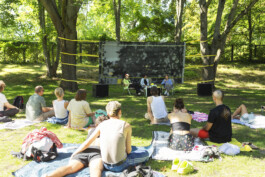
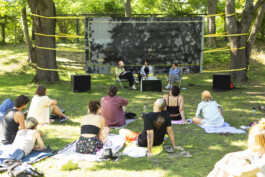
The series of talks conversation pieces takes everyday technologies as its point of departure and situates them within the context of the swimming pool. Each edition starts from a text that provides the thematic framework and serves as a shared point of reference. Guests are invited who engage with the topic from artistic, theoretical, or technological perspectives and share their thoughts or their own work through discussion and exchange.
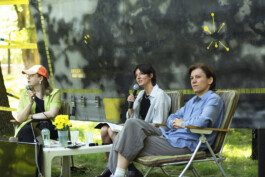
What does it mean to hold, as a technological as much as a cultural practice? And what alternative narratives about technology open up when we stop thinking of it as a tool of conquest? The writer Ursula K. Le Guin wrote mostly science fiction and political utopias, proposing that the history of humanity be understood not as a heroic narrative but as the history of what we carry, what we collect, preserve, and pass on to others. The Carrier Bag Theory of Fiction (1986) forms the starting point for a feminist counter-narrative to the dominant story of technological history. Engaging with questions of infrastructure, care work, and the relationship between speculative feminisms and the political potential of science fiction, Marina Naprushkina and Hannah Wallenfels are in conversation, moderated by Anna-Lena Panter.
The conversation series conversation pieces is curated by Anna-Lena Panter as part of the cooperation between transmediale and Tropez.
The conversations take place in German.
Photo: Marina Naprushkina, Mama, how much longer? video still, 2025, courtesy by the artist
About the curators
transmediale is an annual festival and a space for critical reflection on art and technology. It brings together transdisciplinary communities and diverse audiences interested in digital cultures to develop new perspectives on our technological age. The transmediale festival takes place annually at the end of January and forms the core of the organisation’s programme. In addition to the festival, transmediale organises events, publications, and residency programmes throughout the year. In 2027, the 40th edition of transmediale will take place.
Anna-Lena Panter organises, curates, and edits projects between Berlin and Vienna. Since 2020, she has worked in various roles at transmediale festival in Berlin. She currently coordinates the festival programme and is responsible for year-round studio activities as well as the transmediale residencies. With a background in publishing practices, she organises exhibitions, discursive formats, and gatherings.
Marina Naprushkina is an interdisciplinary artist who works primarily outside institutional spaces, focusing on networks based on self-governance. She investigates possibilities and forms of resilience, feminist narratives, and care networks, informed by intersectional and feminist critique. Since 2013, she has been co-founder of the initiative Neue Nachbarschaft/Moabit, dedicated to building a community of solidarity between people with and without experience of migration.
In various contexts, Hannah Wallenfels asks who thinking belongs to – and who counts as a thinker. Working at the intersection of the history of philosophy and feminist theory, she currently investigates how authorship and authority emerge and shift, and teaches on these questions at various universities. As a co-founder of the theory collective diffrakt, she also develops collective formats beyond the classical lecture: event series, workshops, and reading groups – on themes such as care work, cyberfeminism, canon critique and science fiction.
Sa, 08.08.2026
3 pm
Talk
about 60 minutes
conversation pieces
The series of talks conversation pieces takes everyday technologies as its point of departure and situates them within the context of the swimming pool. Each edition starts from a text that provides the thematic framework and serves as a shared point of reference. Guests are invited who engage with the topic from artistic, theoretical, or technological perspectives and share their thoughts or their own work through discussion and exchange.
What does it mean to hold, as a technological as much as a cultural practice? And what alternative narratives about technology open up when we stop thinking of it as a tool of conquest? The writer Ursula K. Le Guin wrote mostly science fiction and political utopias, proposing that the history of humanity be understood not as a heroic narrative but as the history of what we carry, what we collect, preserve, and pass on to others. The Carrier Bag Theory of Fiction (1986) forms the starting point for a feminist counter-narrative to the dominant story of technological history. Engaging with questions of infrastructure, care work, and the relationship between speculative feminisms and the political potential of science fiction, Marina Naprushkina and Hannah Wallenfels are in conversation, moderated by Anna-Lena Panter.
The conversation series conversation pieces is curated by Anna-Lena Panter as part of the cooperation between transmediale and Tropez.
The conversations take place in German.
Photo: Marina Naprushkina, Mama, how much longer? video still, 2025, courtesy by the artist
About the curators
transmediale is an annual festival and a space for critical reflection on art and technology. It brings together transdisciplinary communities and diverse audiences interested in digital cultures to develop new perspectives on our technological age. The transmediale festival takes place annually at the end of January and forms the core of the organisation’s programme. In addition to the festival, transmediale organises events, publications, and residency programmes throughout the year. In 2027, the 40th edition of transmediale will take place.
Anna-Lena Panter organises, curates, and edits projects between Berlin and Vienna. Since 2020, she has worked in various roles at transmediale festival in Berlin. She currently coordinates the festival programme and is responsible for year-round studio activities as well as the transmediale residencies. With a background in publishing practices, she organises exhibitions, discursive formats, and gatherings.
Marina Naprushkina is an interdisciplinary artist who works primarily outside institutional spaces, focusing on networks based on self-governance. She investigates possibilities and forms of resilience, feminist narratives, and care networks, informed by intersectional and feminist critique. Since 2013, she has been co-founder of the initiative Neue Nachbarschaft/Moabit, dedicated to building a community of solidarity between people with and without experience of migration.
In various contexts, Hannah Wallenfels asks who thinking belongs to – and who counts as a thinker. Working at the intersection of the history of philosophy and feminist theory, she currently investigates how authorship and authority emerge and shift, and teaches on these questions at various universities. As a co-founder of the theory collective diffrakt, she also develops collective formats beyond the classical lecture: event series, workshops, and reading groups – on themes such as care work, cyberfeminism, canon critique and science fiction.
TROPEZ
at Sommerbad Humboldthain
Wiesenstraße 1, 13357 Berlin
Google Maps
Monday – Sunday
10.00 am – 6.00 pm


TROPEZ
at Sommerbad Humboldthain
Wiesenstraße 1, 13357 Berlin
Google Maps
Monday – Sunday
10.00 am – 6.00 pm

